President Trump's aggressive tariff policies are reshaping global commodity markets, creating unprecedented volatility for businesses across sectors.
The recent implementation of 25% tariffs on steel and aluminium imports, coupled with the looming threat of similar measures on copper, has triggered immediate price surges and supply chain disruptions that reverberate throughout the economy. This volatility is further amplified by the on-again, off-again nature of trade policy implementation.
Tariffs can be announced, paused, modified, and escalated within days, as demonstrated by the recent 'Reciprocal Tariff Plan,' which saw tariffs on Chinese goods fluctuate from 10% to 125%, while tariffs on other countries, initially escalated, were paused for 90 days, all within a single week. This policy whiplash leaves businesses in a perpetual state of uncertainty, unable to confidently plan or secure stable supply chains.
U.S. copper prices have already experienced significant premiums over global benchmarks, with the COMEX-LME price gap widening to over $1,200/tonne in recent weeks as traders rush to stockpile inventory ahead of potential tariff implementation. For businesses dependent on these metals, this new reality presents a complex strategic challenge.
This volatile landscape necessitates a fundamental shift in how organizations approach planning and decision-making. The once stable trade environments can no longer serve as a reliable basis for effective business planning.
How can organizations commit to a 5-year strategic plan when tariff policies can change overnight?
Why Traditional Planning Approaches Fall Short in the Tariff Era
Traditional planning approaches that primarily extrapolate historical data at an aggregated outcome level are particularly vulnerable in today's trade policy environment. When a 25% tariff can be announced and implemented within weeks, forecasts based on historical data quickly become obsolete.
Quantifying the additional impact at the outcome level is challenging because the financial model does not isolate levers with the necessary granularity to rapidly run scenarios. Fixed budgets and rigid planning cycles leave businesses unable to respond to sudden cost increases or supply chain disruptions. This new reality demands a more dynamic, agile approach to financial planning and analysis, one that can rapidly assess the impact of policy changes across the entire value chain and enable swift, informed decision-making.
Driver-based modelling provides precisely this capability, offering a framework that connects underlying drivers, including macro-economic assumptions, to operational and financial outcomes. While many companies have adopted more agile planning methods, a significant number still depend on traditional approaches. Even those transitioning to modern methods may face challenges in full implementation.
This underscores the need for continuous adaptation in planning processes to maintain competitiveness in a rapidly changing market.
Integrated Driver-Based Modelling
The foundation of a modern planning capability is an integrated driver-based model that facilitates scenario modelling. Driver-based forecasting offers a dynamic and responsive approach by directly linking financial outcomes to key business drivers.
Unlike traditional methods that rely on top-line forecasting and adjustments to historical outcomes, driver-based models focus on specific factors influencing performance. Assumptions made at the driver level are inherently more accurate because they are based on specific, measurable factors that directly influence outcomes. This approach allows businesses to adapt quickly to changes, providing a more accurate and reliable framework for decision-making.
By establishing a direct connection between inputs, drivers, and outputs, driver-based models enable organizations to conduct scenario analyses and adjust forecasts in real-time. This flexibility is crucial in today's volatile economic environment, where businesses must be prepared to respond to sudden shifts in market conditions.
Let’s demonstrate the complexity of managing a business in this environment by way of an example.
Illustrative Example:
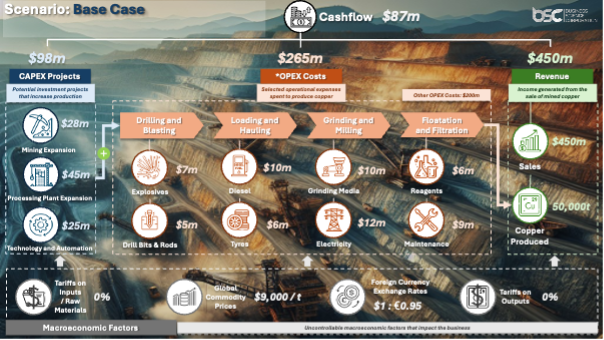
A Base Metals Mining Company in a Tariff-Affected Geography
Consider a base metals mining company operating in a region impacted by steel and aluminium tariffs. These tariffs can significantly alter the company's cost base, affecting decisions across various aspects of the business.
-
Cost Base Impacts:
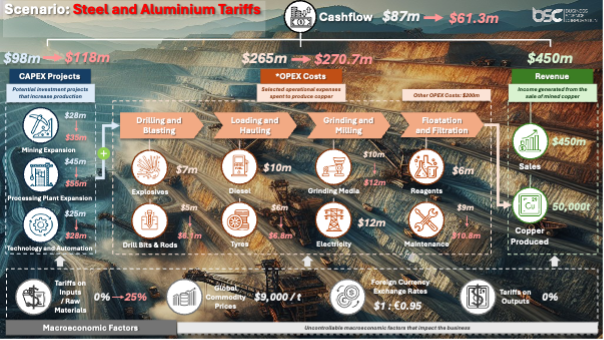
Tariffs typically lead to a marginal increase in inflation across the economy, indirectly affecting the overall cost base of the operation. Additionally, specific costs for items directly impacted by tariffs, such as steel mill balls used in the milling operations in a mine, will rise. The business will need to consider alternative suppliers and, in some cases, alternative processes where the availability of certain consumables might become limited. When making business decisions, it is essential to have the capability not only to capture the broad increases in costs but also the specific impacts on tariff-affected items. A driver-based model allows for key consumables and cost rates to be adjusted independently. Accurately predicting these cost dynamics and understanding their effects on profitability and competitiveness are crucial for shaping the company's strategic direction. -
CAPEX Projects and Expansions:
Projects and expansions that rely heavily on steel and aluminium construction will face increased capital expenditure and must be re-evaluated. The company needs to reassess ongoing and future projects with updated cost bases to determine their feasibility under new conditions and assess their impact on the overall business. Having a tool that easily allows for reassessing the feasibility of the projects, given changes to specific assumptions as well as overlays those projects have on the overall business is critical for ensuring a good Capex strategy.
-
Production Considerations:
A driver-based model allows the company to explore different production profiles to manage costs while tariffs are high. For instance, if mill ball costs increase significantly, the company might choose to mine softer ore initially to reduce operational costs. If the cost base is not competitive globally, some pits or shafts might not be viable, leading to considerations of putting certain operations into care and maintenance. -
Revenue Impact:
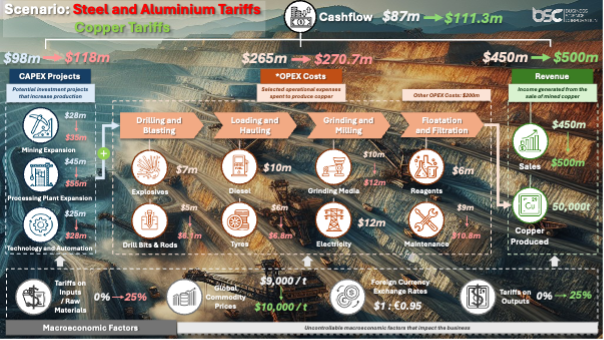
Whilst the initial points focus on challenges, the impending copper tariffs also present potential opportunities. As outlined in the introduction, the U.S. is actively considering implementing tariffs on copper imports, which would likely lead to higher domestic prices. This could present a lucrative opportunity for U.S.-based copper producers. In this context, driver-based modelling becomes essential. By incorporating off-take agreements and freight routes into the model, the company can accurately quantify potential upside.
For example, the driver-based model in the example above reveals that while the copper mine will face an increase in operating costs due to steel tariffs, the premium on domestic copper prices would more than offset this challenge, increasing overall profitability. This potential increase in revenue could significantly alter the company's approach to cost management, CAPEX decisions, and production strategies. If revenue rises substantially, the company might consider expansion opportunities. A higher cost base might become palatable, and instead of reducing production, the company might want to increase it. Additionally, the feasibility of CAPEX projects and expansions might improve with increased revenue. Understanding this balance is crucial to deciding whether to pursue an aggressive or conservative strategy. A driver-based model allows for quick adjustments to these assumptions, optimising value within the organization.
-
Overall Portfolio Considerations:
Whilst the example has been focused on a single asset so far, the complexity escalates significantly for a larger commodities company managing a diverse portfolio of assets, including mines, smelters, and refineries spread across various geographies. The challenge of managing this portfolio is compounded by the need to navigate multiple off-take agreements, tolling arrangements, and tariffs. An integrated driver-based model of the value chain enables efficient management of each asset, as well as material delivery and sourcing strategies across assets, aligning operational decisions with strategic objectives. This approach is essential for optimising value across the organization, rather than just at an individual asset level.
Conclusion:
Driver-Based Modelling as an Essential Tool in Tariff Uncertainty
The importance of a driver-based model lies in its ability to flex different assumptions in a swift and integrated manner across the business. This capability is crucial for balancing the impact of tariffs on input costs with potential benefits on selling prices. Without such a model, managing these complexities becomes extremely challenging, especially for companies with extensive operations and diverse geographical footprints.
As we've seen, the current tariff environment creates both challenges and opportunities for businesses. The winners in this new landscape will be those who can quickly assess the impact of policy changes, model different scenarios, and adapt their strategies accordingly. Driver-based modelling provides exactly this capability, enabling businesses to:
- Quantify the direct and indirect impacts of tariffs across the value chain.
- Identify which parts of the business are most vulnerable or advantaged.
- Test alternative strategies before committing resources.
- Communicate the rationale for strategic shifts to stakeholders
As businesses continue to navigate uncertain trade environments, adopting a driver-based forecasting approach is no longer optional, it's essential for survival and success. It empowers organizations to make informed decisions, optimise strategies, and seize opportunities in a rapidly changing world.
Keep an eye out for our next article, where we will delve deeper into integrating sensitivity analysis and stochastic modelling into your planning toolkit to drive better risk management and planning in the face of continued trade policy uncertainty.
The Planning Science division of BSC specialises in helping businesses navigate exactly these types of challenges.
Through our proprietary Qerent Platform, we develop sophisticated driver-based financial models that enable our clients to conduct scenario testing and tailored analysis for strategic planning, capital optimisation, and risk modelling, particularly valuable in today's volatile trade environment.
Our approach has helped numerous commodity producers not only weather tariff-related disruptions but identify hidden opportunities within these challenges.